
Mandatory and Voluntary Products in BIS Certification: Complete Guide
Introduction to BIS Certification
The Bureau of Indian Standards (BIS) ensures product quality, safety, and reliability in India. BIS certification is essential for manufacturers and importers to sell products legally and build consumer trust.
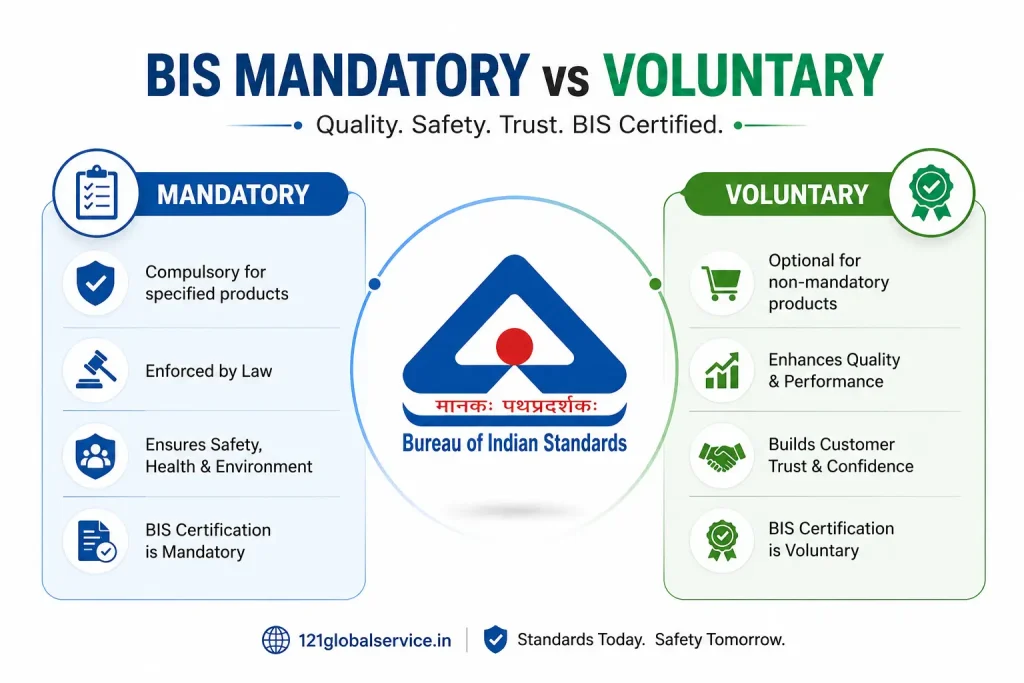
BIS certification is broadly divided into mandatory and voluntary certification depending on regulatory requirements.
What is Mandatory BIS Certification?
Mandatory certification is legally required for specific products listed under Quality Control Orders (QCOs).
- Required by law
- Ensures public safety
- Applies to manufacturers and importers
- Non-compliance leads to penalties
Examples
- Electronics (LED lights, mobiles)
- Electrical appliances
- Cement & construction materials
- Steel products
Certification schemes include ISI, CRS, and FMCS.
What is Voluntary BIS Certification?
Voluntary certification is optional and used by businesses to enhance product quality and brand trust.
- Improves customer confidence
- Better market positioning
- Competitive advantage
- Useful for tenders
Difference Between Mandatory and Voluntary Certification
| Feature | Mandatory | Voluntary |
|---|---|---|
| Requirement | Legally required | Optional |
| Compliance | Must comply to sell | Not compulsory |
| Purpose | Safety & regulation | Branding & quality |
| Risk | Legal penalties | No legal risk |
| Market Impact | Entry requirement | Competitive advantage |
BIS Certification Process
- Application submission
- Product testing
- Factory inspection
- Certification approval
- Use of BIS/ISI mark
Why BIS Certification is Important
- Legal compliance
- Improved product quality
- Customer trust
- Market expansion
- Avoid legal risks
How 121 Global Services Can Help
- ✔ Documentation support
- ✔ Testing coordination
- ✔ Application filing
- ✔ BIS liaison
- ✔ End-to-end support
Conclusion
Understanding mandatory and voluntary BIS certification helps businesses comply with regulations and build strong market credibility.
Start Your BIS Certification Today
Get expert guidance for mandatory or voluntary certification.
💬 Contact Expert